
Artificial intelligence has changed what computers can do with information. Machine learning systems can identify patterns across enormous datasets, generate content, make predictions, recognise images and speech, recommend actions, and increasingly perform sequences of tasks with limited human intervention.
But AI’s progress has also exposed a deeper question: what happens when better intelligence requires more than better algorithms and larger datasets?
Some problems are difficult not because we lack data, but because the underlying computation becomes extraordinarily complex as the number of possibilities grows. Optimisation, molecular simulation, materials discovery, portfolio construction, logistics, and certain scientific problems can involve vast search spaces that become difficult for classical computers to explore efficiently.
This is where quantum computing enters the conversation.
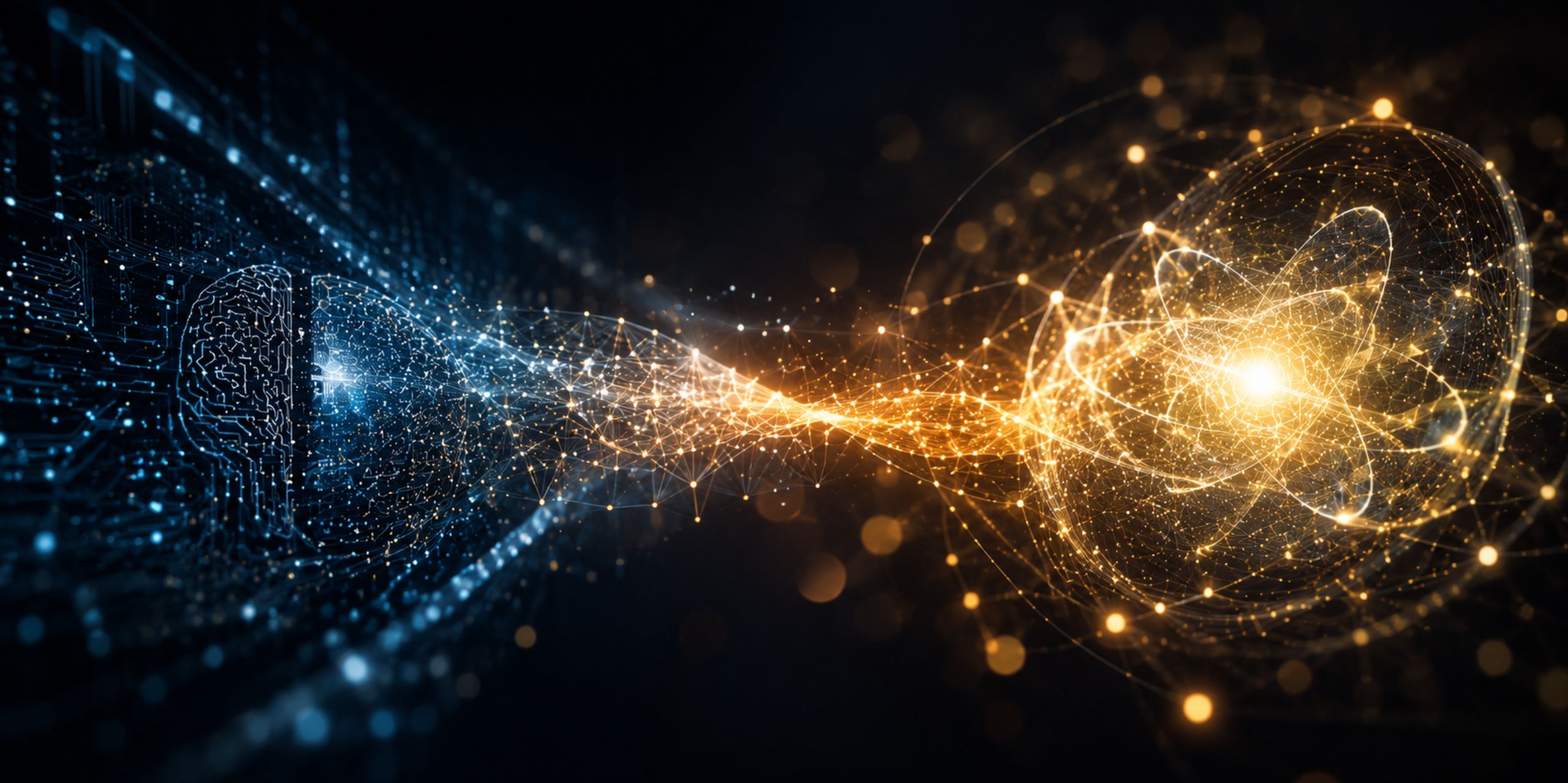
The transition from artificial intelligence to Quantum Intelligence should not be understood as replacing today’s AI with a futuristic quantum computer. A more useful interpretation is that intelligent systems may gradually become heterogeneous, combining classical AI with specialised forms of computation, including quantum algorithms where they offer a genuine advantage.
That distinction matters. Quantum computing is not automatically “smarter” than classical computing, and Quantum Intelligence is not simply another name for quantum AI. The more interesting possibility is a new generation of intelligent systems in which different computational technologies contribute different capabilities.
From Rules to Learning
The history of artificial intelligence can be viewed partly as a progression in how machines represent and process knowledge.
Early AI systems relied heavily on explicitly defined rules. If a system encountered condition X, it could be programmed to perform action Y. These approaches were useful in constrained environments but struggled when the real world became too variable to describe through manually constructed rules.
Machine learning changed the model.
Instead of specifying every rule, developers could provide data and algorithms capable of learning patterns from it. Neural networks and later deep-learning systems expanded this capability dramatically. Modern AI can construct representations from complex data and use those representations for prediction, classification, generation, and decision-making.
This shift can be summarised as:
Rules → Data → Learning → Prediction → Action
The important change was not simply that computers became faster. The relationship between computation and information changed.
AI systems increasingly became capable of extracting useful structure from information without every relationship being explicitly programmed.
Yet learning from data is only one dimension of intelligence.
An intelligent system also needs to reason about possibilities, constraints, uncertainty, resources, physical systems, and consequences. Some of these problems are computationally difficult even when the relevant data is available.
That creates the opening for the next stage.
The Computational Problem Behind Intelligence
Imagine an AI system responsible for designing an efficient delivery network.
It might predict customer demand, estimate travel times, identify purchasing patterns, and forecast inventory requirements. Those are problems where machine learning can be extremely useful.
But eventually the system has to decide:
Which combination of routes, vehicles, warehouses, schedules, and resources produces the best overall outcome?
That is an optimisation problem.
As the number of variables increases, the number of possible combinations can grow rapidly. Classical algorithms can solve many optimisation problems effectively, and sophisticated optimisation methods continue to improve. But some classes of problems remain computationally difficult.
The same issue appears in other domains.
A scientific system might need to explore possible molecular configurations. A financial system might evaluate complex portfolios under multiple constraints. An energy system might need to balance supply, demand, storage, and network limitations.
AI can help identify patterns and make predictions. But prediction does not necessarily solve the underlying computational problem.
This is one reason the relationship between AI and quantum computing is becoming important.
Quantum Computing Changes the Computational Layer
Quantum computing approaches computation differently from classical computing. Instead of operating exclusively on classical bits, quantum computers use quantum bits, or qubits, whose behaviour is governed by quantum mechanics.
Quantum algorithms can exploit properties such as superposition, interference, and entanglement to approach certain computational problems in fundamentally different ways.
That does not mean a quantum computer simply tries every possible answer simultaneously and instantly chooses the best one. That popular description is misleading.
The practical question is much narrower:
Are there particular problems for which a quantum algorithm can extract useful computational advantages that classical approaches cannot match efficiently?
Research into quantum computing and machine learning is actively exploring this question. IBM’s Quantum Machine Learning material, for example, describes QML as an area where quantum computing may augment existing classical machine-learning workflows, while also emphasising that finding problems genuinely suited to quantum approaches remains difficult.
This is crucial to understanding the transition toward Quantum Intelligence.
The quantum component does not need to replace AI.
It may instead become another computational layer available to an intelligent system.
AI and Quantum Computing Are More Likely to Converge Than Compete
The most realistic near-term model is not:
AI → Quantum AI
It is closer to:
AI + Classical Computing + HPC + Quantum Computing + Simulation
Each component can perform the work for which it is best suited.
A classical machine-learning model might process historical data.
A high-performance computing system might run a large simulation.
A quantum processor might execute a specialised optimisation or simulation subroutine.
A classical system could then analyse the output and feed the result back into the larger AI workflow.
This creates a fundamentally different architecture for intelligence.
A Hybrid Intelligent Workflow
A simplified example might look like this:
Data → AI Model → Identify Difficult Subproblem → Specialised Quantum Computation → Classical Analysis → Decision → New Data → AI
The quantum processor is not necessarily the “brain” of the system.
It is a specialised computational instrument.
That distinction makes the idea of Quantum Intelligence considerably more practical.
Where Quantum Machine Learning Fits
Quantum machine learning sits directly at the intersection of these developments.
QML explores ways of using quantum computing within machine-learning processes. This can involve quantum versions of learning algorithms, quantum feature maps, quantum kernels, variational quantum circuits, or hybrid classical-quantum models.
Research published through IBM Research describes QML as a two-way interaction: quantum computing can be used for machine learning, while machine-learning techniques can also help advance quantum computing itself.
That second direction is particularly important.
The relationship is not simply:
Quantum computing makes AI better.
AI can also help make quantum computing better.
A 2025 review in Nature Communications examined how AI techniques are already being applied across the quantum-computing stack, including hardware design, preprocessing, device control, optimisation, error correction, postprocessing, and algorithm development. The authors also distinguish this established research direction, “AI for quantum,” from the more speculative question of “quantum for AI.”
The two technologies therefore form a feedback loop.
AI can help build useful quantum computers.
Quantum computers may eventually expand what intelligent systems can compute.
That is a more interesting transition than the simple idea of one technology replacing another.
From AI That Learns to Intelligence That Computes Differently
The deeper significance lies in understanding why Quantum Intelligence matters: not because quantum computers become conscious or inherently more intelligent, but because they may expand the computational capabilities available to intelligent systems.
The shift is computational.
Modern AI is exceptionally good at extracting structure from data. Quantum computing may eventually provide new ways of processing certain difficult computational structures.
That suggests a broader conception of intelligence:
| Stage | Primary capability | Computational emphasis |
| Rule-based AI | Apply predefined knowledge | Logic and rules |
| Machine Learning | Learn patterns from data | Statistical computation |
| Deep Learning | Learn complex representations | Large-scale numerical computation |
| Generative AI | Generate and transform information | Massive model computation |
| Hybrid AI | Combine multiple computational approaches | Heterogeneous computing |
| Quantum Intelligence | Integrate intelligent reasoning with quantum-enabled computation where useful | Classical + quantum + specialised computation |
This should not be interpreted as a rigid historical timeline. These approaches coexist, and each remains useful.
The point is that the definition of an intelligent system may gradually expand from learning from information to selecting and coordinating the right computational mechanism for a problem.
That is a much more consequential idea.
What Could Become Possible?
The strongest potential applications are not necessarily conventional AI tasks.
Classical machine learning is already highly effective for many problems. IBM’s current quantum-learning material explicitly notes that it is unrealistic to expect quantum speedups for machine-learning tasks that classical computers already solve efficiently.
The opportunity instead lies in problems where computational complexity becomes a serious constraint.
Scientific Discovery
Quantum computers are particularly interesting for problems involving quantum mechanical systems themselves. Molecular and materials simulation is one of the major areas where quantum computation could eventually provide capabilities difficult to reproduce classically.
AI can help search scientific data, identify promising candidates, generate hypotheses, and analyse experimental results. Quantum simulation could potentially become another tool in that discovery pipeline.
This produces a powerful loop:
AI → Hypothesis → Quantum Simulation → Classical Analysis → Experiment → New Data → AI
Artificial intelligence provides the learning and reasoning layer. Quantum computing potentially contributes a new computational method for specific scientific questions.
Optimisation
Large-scale optimisation provides another possible intersection.
Scheduling, logistics, portfolio construction, network design, resource allocation, and manufacturing configuration can involve enormous combinations of possible decisions.
Quantum optimisation algorithms are being investigated for selected classes of such problems. But the relevant standard is not whether a quantum algorithm sounds theoretically interesting. It is whether it can outperform the best practical classical alternatives under realistic conditions.
That distinction separates credible Quantum Intelligence from technological hype.
New Forms of Simulation
Some of the most significant long-term applications may involve simulating physical systems that are inherently quantum.
This could affect chemistry, materials science, pharmaceuticals, energy technologies, and scientific research.
The implication is subtle but important: the value of quantum computing may not be primarily about making today’s AI models marginally faster. It could instead enable intelligent systems to interact with computational representations of reality that are difficult to construct using classical methods.
The Transition Will Not Happen Overnight
Quantum Intelligence remains an emerging concept, and much of its strongest potential remains conditional.
Current quantum computers face significant constraints involving noise, error rates, scaling, data encoding, algorithm design, and the integration of quantum processors into practical classical workflows. Research surveys continue to identify hardware quality, speed, scale, and other bottlenecks as major barriers to broad QML advantage.
This means the transition should not be presented as:
AI is ending. Quantum Intelligence is beginning.
The actual trajectory is likely to be much less dramatic.
AI will continue improving.
Classical computing will continue improving.
High-performance computing will continue improving.
Quantum computing will develop alongside them.
The intelligent systems of the future may use all of these technologies simultaneously.
The Real Shift: From Single Technology to Computational Ecosystem
This may ultimately be the most important change.
The history of computing is often told as a sequence of dominant technologies: mainframes, personal computers, mobile devices, cloud computing, accelerated computing, and AI.
The next phase may not produce another single dominant architecture.
Instead, intelligent systems could become computational ecosystems.
A single system could use CPUs for general processing, GPUs or specialised accelerators for AI workloads, high-performance computing for simulations, and quantum processors for carefully selected problems.
The intelligence would come from coordinating these capabilities.
That changes how we should think about the word “intelligence.”
Intelligence would no longer be defined only by how effectively a model learns from data. It would also involve how effectively a system:
- understands a problem,
- identifies relevant information,
- reasons about uncertainty,
- selects an appropriate computational approach,
- combines outputs from different systems,
- evaluates possible outcomes,
- makes decisions,
- and learns from what happens next.
Quantum computing could become one component of that architecture.
Not the whole architecture.
From Artificial Intelligence to Quantum Intelligence
The transition from AI to Quantum Intelligence is therefore better understood as an expansion of the computational foundation of intelligent systems.
Artificial intelligence demonstrated that machines could learn useful patterns from data.
Generative AI demonstrated that models could produce increasingly sophisticated forms of information and interaction.
Quantum computing introduces a different possibility: certain computational problems may eventually be approached using fundamentally different physical principles.
The convergence of these ideas could produce systems that do more than learn.
They could learn, simulate, optimise, reason, and coordinate computation across multiple paradigms.
But the important word is could.
Quantum advantage remains problem-specific, and demonstrating a theoretical or laboratory advantage is not the same as producing a meaningful business advantage. IBM’s educational material similarly emphasises that identifying genuinely quantum-suitable problems remains an open and difficult task.
That is why Quantum Intelligence should not be framed as a guaranteed successor to artificial intelligence.
A better interpretation is that AI may be entering a broader computational era.
The next generation of intelligent systems may not ask only, “What can we learn from this data?”
They may also ask:
“What kind of computation does this problem require?”
That is where the journey from Artificial Intelligence toward Quantum Intelligence becomes meaningful.
The destination is not a world where quantum computers replace AI.
It is a world where intelligence can draw on a much larger computational toolkit.
And if that happens, the defining advantage may not belong to the system with the biggest model or the fastest processor. It may belong to the system capable of knowing which form of computation to use, when to use it, and how to combine its results into better decisions.
Sources
- IBM Quantum Learning — Introduction to Quantum Machine Learning
- IBM Research — Quantum Machine Learning
- IBM Research — Quantum Machine Learning: An Interplay Between Quantum Computing and Machine Learning
- Nature Communications — Artificial intelligence for quantum computing
- IBM Research — Systematic literature review: Quantum machine learning and its applications
- NIST — Assessing the Benefits and Risks of Quantum Computers



Leave a Reply